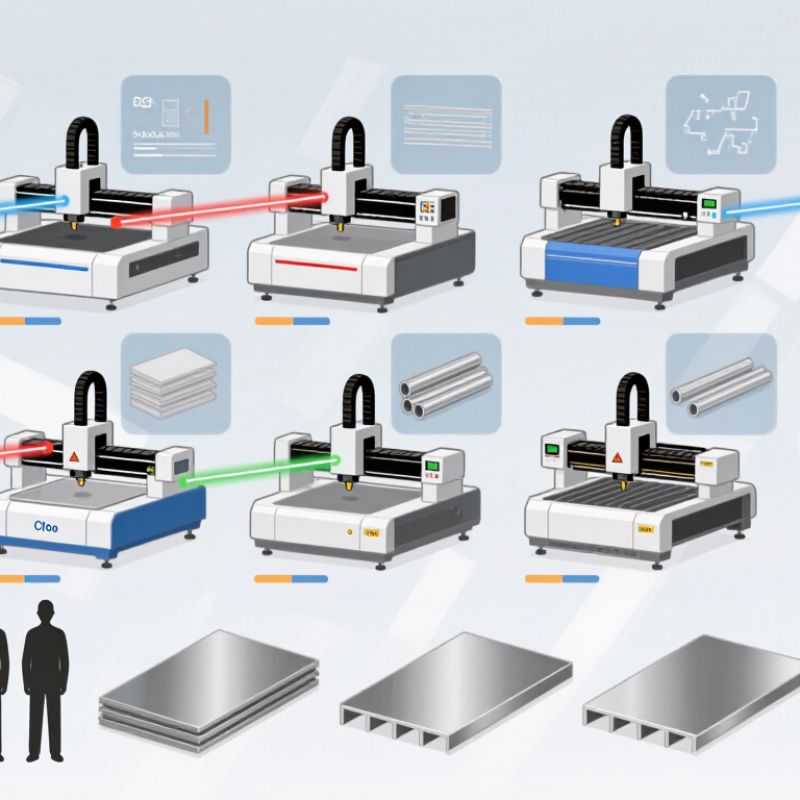
| 1 | Continuous-Wave Fiber Laser | Approximately 1,030–1,080 nm | 1–30 kW | Carbon steel, stainless steel, aluminum, brass, copper, galvanized sheet | Thin sheet to approximately 40 mm steel, depending on power and process conditions | High electrical efficiency, fast sheet cutting, compact optical path, low routine maintenance | Reflective metals require suitable process settings; very thick sections may need slower cutting or alternative processes |
| 2 | CO₂ Laser | Usually 10.6 μm; some systems operate near 9.3 μm | 1–20 kW | Carbon steel, stainless steel, acrylic, wood, plastics, textiles, rubber, glass and composites | Thin materials to approximately 20–25 mm metal and substantially thicker nonmetallic materials | Excellent performance on many nonmetals; mature technology; good edge quality on thick organic materials | Lower wall-plug efficiency, larger beam-delivery system and more consumable maintenance than many fiber systems |
| 3 | Nd:YAG Laser | Approximately 1,064 nm | 0.5–6 kW continuous wave; lower average power for pulsed systems | Steel, stainless steel, aluminum, nickel alloys, titanium and selected reflective metals | Approximately 0.1–10 mm for common industrial cutting applications | Good focusability and compatibility with fiber delivery; suitable for precision cutting and welding | Generally less energy-efficient and more maintenance-intensive than modern fiber sources |
| 4 | Thin-Disk Laser | Approximately 1,030–1,080 nm | 2–16 kW | Carbon steel, stainless steel, aluminum, copper, brass and high-strength alloys | Thin sheet to approximately 25–30 mm steel in suitable high-power configurations | High beam quality at high power, good thermal management and strong performance in demanding industrial production | More complex and expensive architecture; specialist servicing may be required |
| 5 | Direct-Diode Laser | Approximately 800–1,000 nm | 1–20 kW | Copper, brass, aluminum, stainless steel, coated metals and selected polymers | Thin sheet to approximately 10–15 mm metal, depending on beam quality and power | High electrical efficiency and strong absorption in some reflective metals; simple solid-state design | Beam quality can be lower than fiber or disk lasers, which may limit very fine kerf work |
| 6 | Pulsed Fiber Laser | Approximately 1,030–1,080 nm | 20–1,000 W average power; high peak power in short pulses | Thin stainless steel, nickel alloys, titanium, aluminum, copper, foils and precision components | Foil and thin sheet, commonly below approximately 3 mm | Low heat input, narrow kerf, precise edge control and excellent suitability for small or delicate parts | Slower or unsuitable for heavy plate; process quality depends strongly on pulse width and frequency |
| 7 | Ultraviolet Solid-State Laser | Commonly 355 nm; other harmonics are also used | 5–100 W for many industrial micromachining systems | Polymers, ceramics, glass, thin metals, electronics materials, films and medical components | Micromachining applications from films and foils to approximately 1 mm, depending on material | Small heat-affected zone and efficient absorption in many nonmetallic materials; high detail resolution | Lower power and higher source cost; optics and process conditions require careful control |
| 8 | Excimer Laser | Approximately 193–351 nm, depending on the gas mixture | Typically tens to several hundred watts average power | Polymers, thin films, semiconductor materials, ceramics and specialized medical or optical materials | Micron-scale features, thin films and thin sheets rather than heavy plate | Cold ablation, very fine features and low thermal damage on suitable materials | Gas handling, optical maintenance and higher operating complexity; limited general-purpose metal cutting |
| 9 | Ultrafast Laser | Commonly 1,030 nm, 515 nm or 343 nm | 10–500 W average power with picosecond or femtosecond pulses | Glass, ceramics, sapphire, polymers, composites, thin metals and brittle materials | Microfeatures, thin sheets and precision holes; commonly below approximately 2 mm | Minimal heat-affected zone, high dimensional accuracy and clean processing of difficult materials | High purchase cost, lower throughput for large sections and demanding beam-delivery requirements |
| 10 | Green Laser | Approximately 515–532 nm | 10–500 W, depending on continuous-wave or pulsed design | Copper, brass, gold, silver, aluminum, thin foils and reflective electronic materials | Foil and thin sheet, commonly approximately 0.05–3 mm | Improved absorption in copper and other reflective metals; precise, low-spatter processing | Lower available power and higher system complexity than mainstream infrared fiber cutting systems |