
Blog

What Are Soundproof Aluminum Folding Doors?

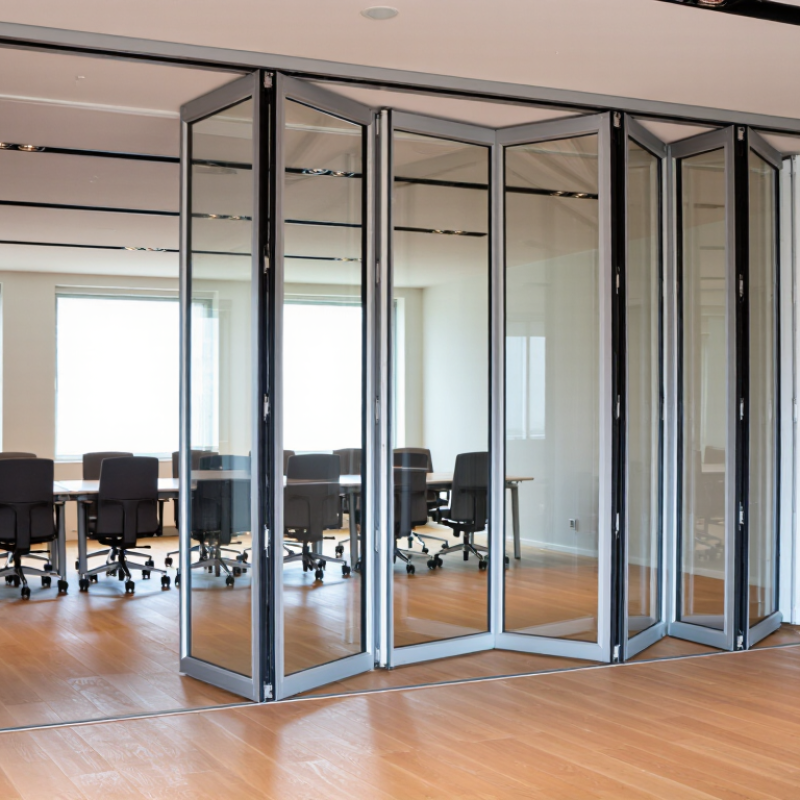
Soundproof aluminum folding doors combine flexible space design with practical noise control. They use hinged panels that fold neatly beside an opening, while aluminum frames provide strength, stability, and a clean architectural appearance. Unlike ordinary folding doors, soundproof aluminum folding doors are designed with acoustic seals, insulated glass, reinforced panels, and carefully fitted tracks.

They can help reduce voices, traffic sounds, meeting-room conversations, and outdoor disturbances. However, “soundproof” does not mean completely silent. Their actual performance depends on glass thickness, panel construction, frame joints, floor alignment, and installation quality. A small gap beneath the door can weaken the entire acoustic system. Even the best materials may perform poorly when fitted carelessly.

In real projects, these doors suit conference rooms, hotel spaces, private offices, studios, restaurants, and adaptable residential interiors. When closed, they create a more controlled acoustic environment. When opened, they connect adjoining areas within seconds. That balance is their main attraction.

Good results require more than a product brochure. Check laboratory sound ratings, gasket quality, panel weight, hardware durability, and available replacement parts. Ask how the system performs after repeated opening and closing. This detail is often overlooked.

They are not perfect.

Sound transmission through walls, ceilings, floors, and ventilation systems can remain noticeable. Therefore, selecting these doors should involve the whole room, not only the doorway. This guide explains their structure, acoustic principles, benefits, limitations, and key purchasing considerations. It also examines where expectations may need adjustment.
What Are Soundproof Aluminum Folding Doors?

Definition and Core Features of Soundproof Aluminum Folding Doors

What Are Soundproof Aluminum Folding Doors?

Definition and Core Features of Soundproof Aluminum Folding Doors

Soundproof aluminum folding doors are multi-panel door systems designed to reduce airborne noise while opening wide. Aluminum provides a rigid, corrosion-resistant frame. It does not create sound insulation by itself. The real performance comes from the complete assembly: laminated glass, insulated cores, compression seals, interlocking panels, and a tightly fitted threshold.

Acoustic performance should be verified through testing. ASTM E90 measures laboratory sound transmission loss, while ISO 10140 evaluates building elements under controlled conditions. Their results may support an STC or Rw rating. These numbers describe tested assemblies, not every installation. A door rated Rw 40 does not guarantee a 40-decibel reduction inside every room. Gaps can quietly defeat expensive materials.

The World Health Organization’s 2018 Environmental Noise Guidelines recommend keeping road traffic noise below 53 dB Lden and 45 dB Lnight. That context explains why sealing details matter in homes, offices, and hospitality spaces. A folding system should include continuous perimeter gaskets, overlapping meeting stiles, and carefully adjusted rollers. Field installation is crucial. Poor alignment can leave a thin light gap, and sound will use it.

Be realistic.

Glass thickness, panel size, wall construction, and nearby ventilation also affect results. Some product descriptions imply “soundproof” means total silence. That claim is too simple. A more reliable specification names the test standard, rating, glass build-up, and installation conditions. Performance may still vary. That uncertainty deserves honest review.


How Soundproof Aluminum Folding Doors Reduce Noise Transmission

What Are Soundproof Aluminum Folding Doors?

How Soundproof Aluminum Folding Doors Reduce Noise Transmission

Soundproof aluminum folding doors are engineered systems, not ordinary lightweight partitions. Their aluminum frames hold laminated or insulated glass, compression seals, and interlocking meeting stiles. These components interrupt sound paths around each folding panel. When closed, the seals press firmly against the frame. Small gaps matter.

The World Health Organization’s Environmental Noise Guidelines for the European Region recommend indoor bedroom noise below 30 dB(A) at night for good sleep. A properly tested door can support this goal, but performance depends on the complete assembly. ASTM E90 measures laboratory sound transmission, while ASTM E413 converts results into an STC rating. These ratings describe controlled conditions, not every installation. A high laboratory score may disappoint on site. That difference is easy to underestimate.

Tips: Specify a tested assembly, not glass alone. Ask for laboratory reports, perimeter-seal details, and the door’s tested STC rating. Use laminated glass when traffic or voices are the main concern. Install the threshold continuously, because one unsealed corner can weaken the whole acoustic barrier. Check walls, ceilings, and adjacent windows too. Sound may simply choose another route. In practice, careful installation often matters as much as the frame material. The design can be excellent, yet the result may still be imperfect.

Key Materials and Structural Components

Soundproof aluminum folding doors combine lightweight metal framing with layered acoustic barriers.

The aluminum frame provides stiffness, corrosion resistance, and stable panel alignment. However, aluminum alone does not block much sound. Its performance depends on the complete assembly.

Acoustic laminated glass is often the main sound-control material. A flexible interlayer helps reduce vibration between glass layers, especially across speech and traffic frequencies.

Thicker glass can improve mass, but thickness is not the only factor. Unequal glass layers may perform better than identical layers. Results still depend on the tested frequency range.

Inside the frame, polyamide thermal breaks can reduce heat transfer and limit metal-to-metal vibration paths.

EPDM or similar elastomeric gaskets close narrow gaps around each panel.

Interlocking meeting stiles add another sealing line when the doors fold together.

Bottom tracks, rollers, hinges, and thresholds also matter. A weak threshold can undermine an otherwise strong system.

In field inspections, installation usually decides the final result.

The surrounding wall must be airtight and structurally sound. Even a small gap can carry noticeable noise.

I would not treat “soundproof” as an absolute promise. Acoustic ratings come from controlled tests, while real rooms contain reflections, furniture, and imperfect joints.

A carefully adjusted door can perform well, but maintenance remains part of the design.

Seals compress over time. Rollers may need adjustment. That practical limitation deserves more attention.

Performance Factors, Ratings, and Testing Standards

What Are Soundproof Aluminum Folding Doors?

Performance depends on more than aluminum thickness. Folding leaves create multiple joints, hinges, tracks, and seals. Each gap can transmit voices, traffic noise, or low-frequency vibration. In practice, compression seals and accurate installation often matter more than frame weight.

Laboratories commonly report airborne sound insulation using STC or Rw ratings. These ratings compare tested frequency ranges under controlled conditions. ASTM E90 with ASTM E413, or ISO 10140 with ISO 717, may be used. Air leakage testing, such as ASTM E283, can also reveal weak sealing. A high laboratory rating is not a guarantee. I have seen good-looking systems perform poorly when floors were uneven or seals were misaligned. The rating may describe one complete assembly, not every possible opening size.

Tips: Request the full test report, not only a rating number. Check the tested dimensions, glazing, seals, hardware, and installation method. Ask whether the test measured the entire folding door or a fixed sample. Inspect the bottom seal after repeated operation. Small light gaps deserve attention. Soundproofing is never perfect, and folding doors usually sacrifice some acoustic performance for flexibility. That trade-off should be measured honestly.

Common Applications, Benefits, and Limitations

What Are Soundproof Aluminum Folding Doors?

Soundproof aluminum folding doors combine hinged panels, acoustic glass, flexible movement, and sealed frames. They are designed to reduce noise, not eliminate it. Their performance depends on glass thickness, gaskets, panel joints, tracks, and wall construction. A well-installed door may soften traffic noise, voices, and equipment sounds. However, the surrounding wall can still become the weakest path.

Common applications include conference rooms, hotel suites, home offices, music practice rooms, and restaurants near busy streets. These doors can open wide, helping people connect indoor and outdoor areas. Folded panels also save more usable space than many swinging systems. Aluminum frames resist moisture and need limited maintenance. Clear glass can bring daylight deep into a room, which feels valuable in smaller spaces. In real projects, though, acoustic expectations are sometimes too optimistic.

Tips: Ask for tested acoustic ratings, not just “soundproof” wording. Check the complete wall assembly. Inspect seals and track alignment during installation. Uneven floors can create small gaps, and small gaps matter. Choose laminated acoustic glass when speech privacy is important. Leave room for panel stacking. The doors may look elegant, but frequent movement can increase adjustment needs. A qualified installer should measure noise goals, opening size, and site conditions before recommending a system.

What Are Soundproof Aluminum Folding Doors? - Common Applications, Benefits, and Limitations

Dimension Typical Information Common Applications Benefits and Limitations
Product Definition A folding door system made with hinged aluminum-framed panels, insulated glass or laminated glass, perimeter seals, and a floor or head track. Large openings where occupants need occasional separation without using a permanent wall. Combines space flexibility with acoustic control, but it normally provides less sound isolation than a solid, permanently built wall.
Sound-Control Principle Sound reduction depends on panel mass, glass construction, air gaps, compression seals, frame joints, and installation quality. Meeting rooms, classrooms, offices, hospitality spaces, and residential interiors. Small gaps around the perimeter or between panels can significantly reduce acoustic performance.
Typical Acoustic Rating Many high-performance glazed folding systems are designed around approximately STC 30–45, depending on configuration and testing. Speech privacy, moderate traffic noise reduction, and separation between shared interior spaces. STC values are laboratory results; field performance may be lower because of adjacent walls, ceilings, floors, and installation conditions.
Glass Configuration Laminated glass generally improves sound damping, while insulated glass can improve thermal performance and may support acoustic control when properly specified. Exterior-facing rooms, conference areas, studios, and spaces exposed to intermittent noise. Thicker or specialized glass increases weight, cost, and hardware requirements.
Panel Operation Panels fold and stack or park to one or both sides, opening a large portion of the doorway. Flexible offices, restaurants, event venues, classrooms, and residential living areas. Provides excellent adaptability, but the stacked panels require storage space and clear operating zones.
Common Applications Used where acoustic separation is important but a fully permanent partition is undesirable. Meeting rooms, training rooms, coworking spaces, hotels, restaurants, schools, clinics, home offices, and media rooms. The system is suitable for moderate sound control, not automatically for critical recording, broadcast, or industrial noise isolation.
Space Flexibility A single opening can function as either an open connection or a separated room. Multi-purpose rooms, banquet halls, adaptable offices, and residential open-plan layouts. Improves space utilization, but frequent operation can increase wear on rollers, hinges, seals, and locks.
Natural Light and Visibility Glazed panels allow daylight and visual connection between spaces while maintaining a physical separation. Offices, classrooms, hospitality interiors, showrooms, and homes. Transparent glass can reduce visual privacy and may transmit more sound than a dense opaque partition.
Durability and Maintenance Aluminum resists corrosion and is relatively lightweight; moving components need regular inspection and cleaning. Commercial interiors, residential renovations, and covered exterior openings where compatible hardware is specified. Debris in tracks, damaged seals, misalignment, and loose hardware can affect smooth movement and acoustic performance.
Thermal Performance Thermal behavior depends on frame design, thermal breaks, glass type, spacer construction, and weather seals. Conditioned offices, residential rooms, sunrooms, and climate-controlled commercial spaces. Folding joints and perimeter seals can create more potential air-leakage points than a fixed wall or fixed window.
Threshold and Accessibility Low or flush thresholds can improve accessibility, while weather-resistant systems may require more substantial sill details. Public buildings, offices, hospitality areas, and residential spaces requiring easier passage. The selected threshold must balance accessibility, drainage, durability, and acoustic sealing requirements.
Installation Requirements Requires a structurally adequate opening, accurate dimensions, level tracks, aligned panels, and continuous sealing. New construction, major renovations, and interior partition upgrades. Poor installation can cause air leaks, difficult operation, uneven panel gaps, and reduced sound isolation.
Main Advantages Flexible room division, daylight access, modern appearance, corrosion-resistant framing, and efficient opening of wide spaces. Projects requiring both visual openness and occasional acoustic separation. Offers more flexibility than a fixed partition, but acoustic performance depends heavily on the complete assembly.
Main Limitations Panel joints, tracks, hinges, and perimeter gaps can limit sound isolation; the system may also cost more than a standard interior door. Less suitable for high-security rooms, professional recording studios, very loud industrial areas, or applications requiring absolute privacy. Specify tested acoustic performance, compatible glass, effective seals, and professional installation rather than relying only on the term “soundproof.”

Note: Acoustic performance varies by door size, glass composition, frame design, seals, hardware, surrounding construction, and installation quality. Request tested ratings for the complete door assembly when sound control is a critical requirement.

Go to Top