Choosing the best Industrial Touchscreen is not simply a matter of selecting the largest display or highest resolution. In a real factory, operators may wear gloves, handle oil-covered tools, or work beneath harsh overhead lighting. The screen must respond accurately, even when fingers are wet or dusty. It should also remain readable beside vibrating machinery and resist repeated cleaning. Small details matter. A weak touch controller can slow production, increase mistakes, and frustrate experienced workers.
Donald Norman, a leading authority on human-centered design, said, “Design is really an act of communication.” That principle applies directly to Industrial Touchscreen selection. A well-designed interface should make alarms clear, controls easy to locate, and essential data visible without confusion. Buyers should examine projected capacitive, resistive, and infrared touch technologies against the actual working environment. They should also check brightness, viewing angles, ingress protection, operating temperature, impact resistance, and glove compatibility. Specifications alone are not enough.
Hands-on testing reveals what brochures often hide. Place the panel near a running motor. Try it with thick gloves. Clean it repeatedly. Watch for delayed responses, glare, or accidental touches. No checklist is perfect. Even a strong Industrial Touchscreen may fail when software, mounting, or network design is overlooked. A careful decision connects hardware performance with operator habits, maintenance routines, and long-term support. The best choice is not always the most expensive model. It is the one that remains dependable when the factory is noisy, hurried, and imperfect.
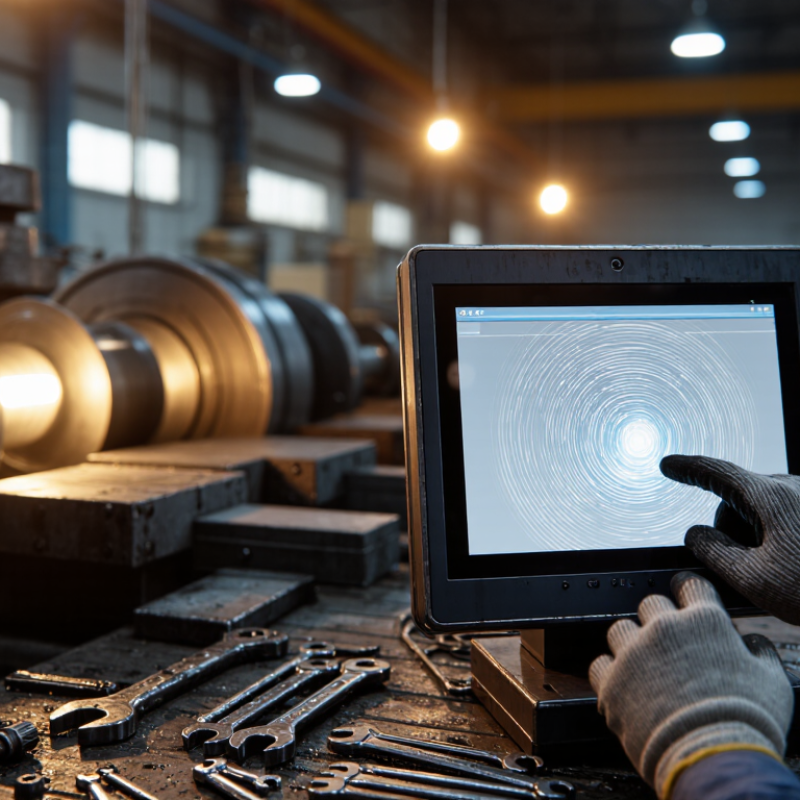
Industrial touchscreen selection begins with the work environment, not the screen size. Dust, oil, gloves, vibration, and temperature can quickly expose weak specifications. According to MarketsandMarkets’ Industrial Displays report, the market is projected to grow from about USD 6.6 billion in 2023 to USD 9.2 billion by 2028. This growth reflects expanding demand for durable operator interfaces.
Start with touch behavior. Will operators wear thick gloves? Will water droplets appear on the panel? Projected-capacitive touch offers smooth interaction, but it may require careful tuning for gloves or moisture. Resistive touch can remain practical in harsh work areas. I have seen operators press wet screens repeatedly, revealing a problem that laboratory testing missed. Small details matter.
Check the full operating range. A panel near a furnace may need extended temperature testing, while a refrigerated warehouse needs stable response below freezing. Review IP ratings under IEC 60529, vibration performance under IEC 60068, and electromagnetic compatibility requirements. MarketsandMarkets also identifies ruggedness, sunlight readability, and reliable operation as important industrial display requirements. Brightness above 1,000 nits may help near windows, but excessive brightness can strain operators in darker rooms. A specification sheet cannot predict every real shift. Test the touchscreen with actual gloves, tools, lighting, and cleaning routines before approval.

Choosing an industrial touchscreen starts with the display, not the enclosure. Display type affects readability, response, power use, and service life. Projected capacitive screens support precise gestures and offer a glass surface that cleans easily. They can struggle with thick gloves, moisture, or accidental touches. Resistive panels respond to pressure and work well with gloves or styluses. However, their softer surface may show wear sooner in busy work areas. That trade-off is easy to underestimate.
Size should match the task, viewing distance, and available mounting space. A 7-inch panel may suit a compact machine, but small status text becomes tiring. A 15- to 19-inch display gives operators more room for charts, alarms, and controls. Oversizing is not automatically better. It can increase cost, heat, and reach distance. Measure the farthest operator position before choosing screen dimensions. Use a consistent interface scale, because extra pixels do not fix poorly designed controls.
Viewing conditions often decide whether a specification works in practice. In direct sunlight, high brightness and an anti-glare surface can preserve detail. Yet excessive brightness may cause eye strain in a dim control room. Wide viewing angles help shared stations, while narrow angles may reduce unwanted reflections. Check contrast at the actual installation point, not only in a showroom. Dust, condensation, and reflective metal surfaces can change the result. I would test the screen with wet fingers, work gloves, and typical lighting. Laboratory ratings help, but they are not the whole story.
| Display Type | Typical Size Range | Typical Resolution | Viewing Angle | Typical Brightness | Best Viewing Conditions | Touch Technology Fit | Main Advantages | Key Limitations |
|---|---|---|---|---|---|---|---|---|
| TN LCD | 7–24 inches | 800 × 480 to 1920 × 1080 | Typically 90°–160° combined | 250–1,000 cd/m² | Indoor control panels and cost-sensitive installations | Resistive or projected capacitive | Fast response, low cost, and efficient operation | Narrower viewing angle and weaker color consistency than IPS |
| IPS LCD | 7–32 inches | 1280 × 800 to 3840 × 2160 | Typically 160°–178° | 300–1,500 cd/m² | Machine interfaces viewed from different angles and shared operator stations | Projected capacitive, resistive, or infrared | Wide viewing angle, stable colors, and strong general-purpose performance | Usually higher power consumption and cost than TN panels |
| VA LCD | 15–55 inches | 1920 × 1080 to 3840 × 2160 | Typically 160°–178° | 350–1,200 cd/m² | Low-light rooms, control rooms, and applications needing strong black levels | Projected capacitive or infrared | High contrast, deep blacks, and good large-format image quality | Potential motion smearing and color shift at extreme viewing angles |
| OLED | 5–32 inches | 1280 × 720 to 3840 × 2160 | Typically 170°–178° | 200–1,000 cd/m² | Indoor applications requiring fast response and high contrast | Projected capacitive | Excellent contrast, fast response, and thin construction | Higher cost, possible image retention, and limited suitability for continuous static content |
| High-Brightness LCD | 7–32 inches | 1280 × 800 to 3840 × 2160 | Typically 160°–178° | 1,000–3,000+ cd/m² | Bright factories, outdoor kiosks, vehicle-mounted equipment, and sunlit areas | Projected capacitive, resistive, or infrared | Improved readability under direct or reflected light | Higher power use, heat output, and cost; brightness alone cannot eliminate reflections |
| Optically Bonded LCD | 7–32 inches | 1280 × 800 to 3840 × 2160 | Determined by the selected LCD panel | 500–2,000 cd/m² | High-vibration, dusty, humid, or high-ambient-light environments | Projected capacitive, resistive, or infrared | Reduced internal reflections, improved impact resistance, and less dust or moisture intrusion | Higher manufacturing cost and more difficult service or panel replacement |
| Installation Condition | Recommended Display Characteristics | Recommended Size | Important Design Considerations |
|---|---|---|---|
| Standard indoor control cabinet | IPS LCD, 300–700 cd/m², projected capacitive touch | 10–15 inches | Prioritize panel cutout dimensions, glove support, and long-term availability |
| Bright factory floor | High-brightness IPS LCD, 1,000 cd/m² or more, anti-glare surface | 10–21 inches | Check reflected-light performance, thermal management, and viewing angle |
| Outdoor or semi-outdoor equipment | 1,500–3,000+ cd/m², optical bonding, anti-reflective treatment | 7–21 inches | Evaluate sunlight readability, operating temperature, water resistance, and UV exposure |
| Wet or washdown area | Sealed projected capacitive or infrared touch with suitable ingress protection | 10–21 inches | Confirm wet-touch behavior, glove operation, chemical resistance, and enclosure sealing |
| Heavy-glove or dirty-hand operation | Resistive touch or industrial projected capacitive touch with glove mode | 7–15 inches | Test touch accuracy, accidental activation resistance, and cleaning compatibility |
| Multi-user monitoring station | Wide-viewing-angle IPS or VA LCD with high contrast | 21–32 inches | Consider screen distance, text size, viewing angle, and mounting height |
An industrial touchscreen must match its environment, not merely look modern. Start with the touch technology. Projected capacitive touch delivers fast, multi-touch control, but gloves, moisture, and metal dust can reduce accuracy. Resistive touch usually works better with thick gloves and pointed tools. Infrared touch supports larger screens, yet its exposed edges may collect debris.
The operating area matters more than the specification sheet. In a wet packaging room, choose a sealed panel with an appropriate IP rating and a surface that tolerates repeated cleaning. In a foundry, sunlight, heat, vibration, and airborne particles demand different testing. I have seen displays pass office trials but fail when operators used wet gloves for entire shifts. That gap is easy to underestimate.
Industrial demand is becoming less forgiving. The International Federation of Robotics reported 541,302 industrial robots installed globally in 2023, a 10% annual increase. Deloitte’s 2024 Smart Manufacturing and Operations Survey found that 86% of respondents viewed smart manufacturing as a major competitiveness driver within five years. Therefore, evaluate readability, response time, glove performance, and cleaning cycles together. Do not trust laboratory claims alone. A factory trial is slower, but often more honest. Also test failure recovery. A screen that freezes briefly can create larger production problems than a screen with lower resolution.
Durability is not a decorative specification. In a factory, oil mist, metal dust, vibration, and wet gloves attack the touchscreen every day. Select an enclosure rated at least IP65 under IEC 60529 for protected front-panel operation. IP66 may be safer where washdown pressure is expected. Confirm the test conditions, because an IP number does not prove resistance to chemicals or repeated impacts. I once chose a screen by brightness alone. That shortcut was a mistake.
Check the operating temperature, shock resistance, and touch technology together. Projected-capacitive touch supports clear multi-touch control, but thick gloves can reduce accuracy. Resistive touch often works better with gloves, though its surface may wear faster. The 2024 Global State of Smart Manufacturing Report states that 95% of manufacturers are investing in, or planning, artificial intelligence and machine learning. That trend increases the need for reliable local displays and stable data links. Brightness above 1,000 nits can improve visibility near windows, but it may increase heat and power demand.
Connectivity should match the existing control network, not only the sales sheet. Confirm Ethernet speed, USB versions, serial ports, PoE needs, and protocols such as Modbus TCP or OPC UA. World Robotics 2024 recorded 4.28 million industrial robots operating worldwide in 2023. More automation means more integration points. Check driver support for the plant’s operating system, screen resolution, VESA mounting pattern, and startup behavior after power loss. Test the complete setup with the actual PLC, gloves, cables, and cleaning routine. Bench testing alone can mislead.
How to Choose the Best Industrial Touchscreen?
Selecting an industrial touchscreen is a performance and total-cost decision, not a simple price comparison. Start with the work environment. A food-processing line may need sealed surfaces, frequent cleaning, and glove operation. A dusty workshop may require strong ingress protection and a bonded display. MarketsandMarkets estimates the global human-machine interface market will grow from about USD 5.6 billion in 2023 to USD 8.4 billion by 2028. That growth reflects wider automation, but it also increases model confusion.
Check brightness, viewing angle, touch response, operating temperature, and expected service life. A screen that works beside a window may fail under direct sunlight. A projected-capacitive panel can feel precise, yet thick gloves may reduce usability. Calculate total cost across five years. Include mounting, cables, software integration, cleaning time, energy use, replacement panels, and downtime. ARC Advisory Group’s research on industrial automation repeatedly highlights lifecycle reliability and maintenance as major ownership factors. A low purchase price can become expensive after one unplanned shutdown.
Tips: Request a sample unit and test it on the actual production floor. Use gloves, wet fingers, dust, and the brightest shift lighting. Ask for failure-rate data and warranty conditions. I once trusted a bright display without checking glove sensitivity; the installation needed an external input device. That mistake was preventable. Also question optimistic claims. A longer warranty is helpful, but it does not replace accessible spares and clear technical support.
The comparison uses typical industrial touchscreen configurations and estimated five-year ownership costs. The Performance Index combines display brightness, projected capacitive touch capability, ingress protection, operating-temperature range, glove usability, and serviceability. Higher performance scores may justify a higher initial investment when uptime and harsh-environment reliability are critical.
Planning estimates are shown for comparison purposes; actual cost depends on enclosure design, interface requirements, installation, maintenance, and replacement cycles.
© 2023 JEM Electronics, Inc. – United States Cable Assembly. All rights reserved.