What Is Galvanized Steel Pipe Round Used For?
Galvanized Steel Pipe Round is widely used where strength, durability, and corrosion resistance matter. Its zinc coating helps protect the steel from moisture, air, and everyday environmental exposure. This makes it practical for water lines, fencing, handrails, greenhouse frames, and structural supports. The familiar silver surface is more than an appearance. It offers a useful layer of protection.
In construction, contractors often choose this pipe for outdoor railings, signposts, scaffolding components, and agricultural frameworks. Its round shape distributes pressure evenly and supports reliable connections with fittings, clamps, or welded joints. Diameters and wall thicknesses vary, so the correct selection depends on load, fluid pressure, temperature, and installation conditions. A small pipe may suit a fence frame. Larger sizes can support heavier structural work.
Performance still requires careful judgment. Galvanizing does not make steel immune to rust. Scratches, cut ends, trapped water, and harsh chemicals can weaken protection over time. This detail is sometimes overlooked. Experienced installers inspect joints and exposed edges before installation. They also confirm product specifications, coating quality, and applicable project standards.
The best use depends on the environment. Indoor dry applications may need less protection, while coastal or industrial areas demand closer evaluation. Galvanized Steel Pipe Round remains a dependable option when selected correctly and maintained realistically. It is not perfect. However, its balance of service life, availability, and practical strength explains why it remains common across residential, commercial, and industrial projects.
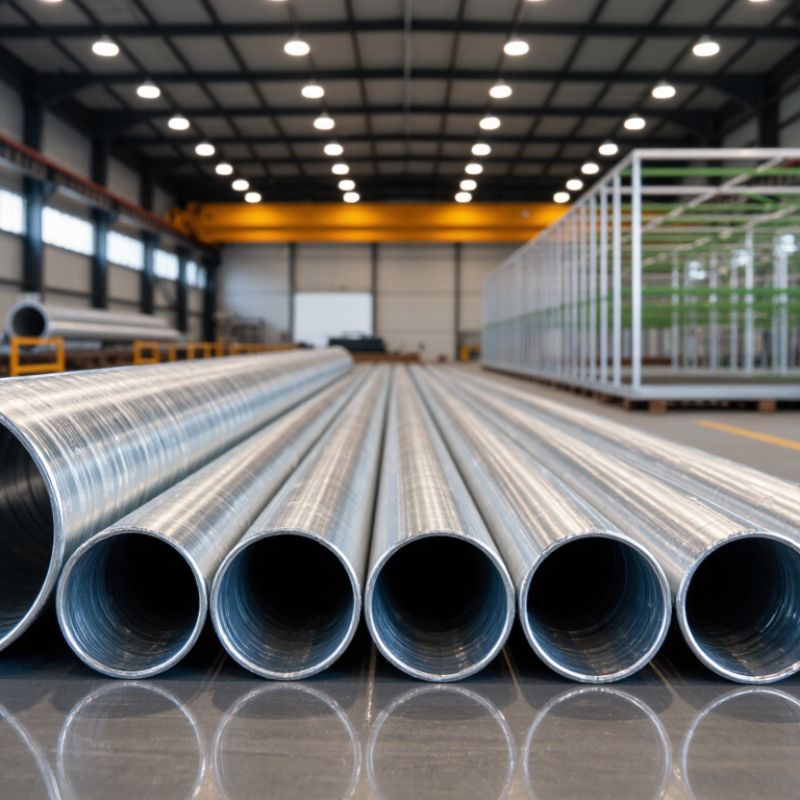
Identify Round Galvanized Steel Pipe Through ASTM A53 and NPS 1/8–26
What Is Galvanized Steel Pipe Round Used For?
Round galvanized steel pipe is commonly used for water lines, compressed air, handrails, fencing, scaffolding, and exposed structural frames. Its zinc coating helps slow corrosion in outdoor and damp environments. However, it is not a universal solution. Soil chemistry, standing water, and damaged threads can shorten service life.
Identification should begin with ASTM A53/A53M. This specification covers welded and seamless steel pipe in NPS 1/8 through NPS 26, with Grades A and B commonly selected for pressure and structural service. ASTM A53/A53M requires a galvanized coating with an average minimum weight of 1.8 ounces per square foot, or about 0.55 kilograms per square metre. The individual minimum is 1.6 ounces per square foot. Check the edition stated on the test certificate.
Measure the nominal size, not only the outside diameter. ASME B36.10M provides the dimensional basis for welded and seamless wrought steel pipe. For example, NPS 2 has a nominal size but an outside diameter of 2.375 inches. Wall thickness changes with the schedule. That detail matters during threading, fitting, and load checks.
Look for the pipe marking.
In field work, I verify NPS, grade, schedule, and galvanizing evidence before cutting. A faded marking can create doubt. Some guides also confuse pipe with round tubing, which uses different dimensional conventions. That mistake is easy to make, and costly to ignore.
Sources: ASTM A53/A53M, Standard Specification for Pipe; ASME B36.10M, Welded and Seamless Wrought Steel Pipe.
Match NPS, Schedule, and Wall Thickness to Pressure and Structural Loads
What Is Galvanized Steel Pipe Round Used For?
Galvanized steel pipe round is used for water lines, fence posts, handrails, frames, and exposed supports. Its zinc coating helps resist moisture and surface corrosion. The coating does not significantly increase the pipe’s structural strength.
NPS identifies the nominal pipe size, while schedule indicates wall thickness. For example, two pipes with the same NPS can have different schedules and different pressure capacities. A larger NPS may improve flow, but it can also increase weight and change support requirements. Check the actual outside diameter, wall thickness, steel grade, temperature, and connection type before selecting pipe. Threads can reduce the effective wall at joints.
Pressure is only one part of the decision. For structural use, evaluate span, bending, axial load, impact, and buckling. A thin-wall pipe may carry water safely but deflect under a long handrail span. A heavier schedule may resist bending better, yet it can still fail if connections are weak or supports are poorly spaced. Small details matter.
Field checks help.
Measure the pipe when possible. Do not rely only on its label. Inspect damaged zinc, open ends, threaded areas, and weld zones. Pressure tables and structural calculations should follow the applicable project code. In practice, schedule selection is sometimes treated as a shortcut. That assumption needs review, especially where people, pressurized water, or overhead loads are involved.
What Is Galvanized Steel Pipe Round Used For?
Match NPS, Schedule, and Wall Thickness to Pressure and Structural Loads
This chart compares nominal pipe sizes with Schedule 40 and Schedule 80 wall thicknesses based on standard carbon-steel pipe dimensions. NPS is a nominal designation rather than the actual outside diameter; the schedule identifies wall thickness. Higher schedules generally provide greater resistance to internal pressure and external loading, but final selection must also consider temperature, corrosion allowance, support spacing, threading, and applicable design codes.
Use Zinc-Coated Pipe in Water, HVAC, Fire Sprinkler, and Utility Systems
Galvanized steel pipe round is used where practical corrosion resistance and mechanical strength matter. Its zinc coating protects the steel from moisture and surface damage. The American Galvanizers Association reports atmospheric zinc corrosion rates near 0.1 micrometers per year in rural conditions, but much higher rates in marine or industrial environments. Location changes everything.
In water systems, installers use galvanized pipe for service lines, pump rooms, and utility connections. Potable-water projects still require local approval and material compliance with NSF/ANSI/CAN 61.
The U.S. Environmental Protection Agency estimates drinking-water infrastructure will require about $625 billion over the next 20 years. That pressure encourages durable materials, although galvanized pipe is not ideal for every water chemistry. Hard water can create scale inside older lines and reduce flow.
HVAC contractors may specify zinc-coated pipe for selected low-temperature water, drainage, equipment connections, and mechanical utility areas. Fire sprinkler systems also use galvanized steel, especially where internal corrosion deserves closer control. NFPA 13 permits steel piping when the system design, fittings, pressure ratings, and corrosion conditions are suitable. Dry and preaction systems often receive careful corrosion review. Small details matter.
The pipe also fits utility racks and exposed service runs. Threaded connections simplify field repairs. Yet cutting threads damages the coating. That weakness is easy to overlook. Inspectors should repair exposed steel and verify wall thickness before commissioning. A coating helps, but it cannot replace water analysis, hydraulic calculations, or experienced installation judgment.
Apply Galvanized Pipe to Fences, Handrails, Scaffolds, and Steel Frames
Galvanized steel pipe round is widely used where strength, clean geometry, and corrosion resistance must work together. Its circular section handles repeated loads well and offers a practical surface for clamps, fittings, and welded connections. The International Organization for Standardization’s ISO 1461 specifies minimum zinc coating requirements for hot-dip galvanized steel. For structural steel thicker than 6 millimeters, the typical minimum coating is 610 grams per square meter, or about 85 micrometers.
Fence builders use galvanized pipe for posts, rails, gates, and livestock barriers. A properly sealed post can tolerate rain, soil moisture, and frequent contact better than unprotected carbon steel. Handrails benefit from the same protection, especially around warehouses, platforms, stairways, and public facilities. The American Galvanizers Association reports that galvanized coatings can provide decades of maintenance-free service, depending on exposure conditions. Site inspections still matter.
Scaffolds and steel frames demand careful design, not just a corrosion-resistant tube. Engineers check wall thickness, buckling length, joint strength, and working loads before installation. Galvanized pipe can reduce repainting work, but cut ends, drilled holes, and damaged surfaces need suitable repair. That detail is often missed. In industrial or coastal environments, zinc may be consumed faster, so coating selection should follow actual exposure data. A practical frame may look simple, yet drainage, ventilation, and connection details decide its service life. Reusing standard pipe sizes can also simplify repairs, although it may limit some custom layouts.
Evaluate Zinc Coatings Above 600 g/m² Against Soil, Moisture, and Corrosion
What Is Galvanized Steel Pipe Round Used For?
Round galvanized steel pipe is used for water lines, fencing, scaffolding, agricultural frames, and structural supports. Its zinc layer separates steel from oxygen and moisture. For buried service, coating mass matters more than appearance. A bright surface does not prove durable protection.
ISO 1461:2022 specifies minimum zinc coating masses by steel thickness. For steel sections above 6 mm, the minimum average coating mass is commonly 610 g/m², equal to roughly 85 micrometres of zinc. Coatings above 600 g/m² therefore provide a practical benchmark for demanding environments. However, thicker zinc is not automatically better in every soil. The Federal Highway Administration identifies soil resistivity, moisture, pH, and chloride content as major corrosion variables. Wet, poorly drained clay can be more aggressive than dry, well-drained sand.
Field experience shows why inspection must continue after installation. Check coating damage at threaded ends, weld zones, and cut edges. Measure coating mass or thickness with calibrated equipment. Soil testing should include resistivity and pH, not only visual classification. The International Zinc Association reports that zinc corrosion rates generally decline as the patina develops, but local conditions can change this pattern. That uncertainty matters. A 600 g/m² coating may perform well for decades in moderate soil, yet require extra design protection in acidic or saline ground. Surface contact with trapped water remains an easy mistake.