
Blog

How to Choose a Humidor Box in 2026?

Choosing the right Humidor Box in 2026 requires more than admiring polished wood and brass hinges. It requires careful attention to humidity control, construction quality, capacity, and daily usability. A beautiful box can still fail if its seal leaks or its hygrometer drifts. Small details matter.

Daniel Marshall, a respected humidor designer and founder of Daniel Marshall Cigars, offers a useful principle: “A humidor should be beautiful, but it must perform first.” That idea remains relevant for modern buyers. Spanish cedar lining, stable humidity, and accurate measurement equipment deserve priority over decoration. Digital sensors may provide convenience, but they still need calibration. Even premium models can need adjustment.

Look closely.

This guide explains how to compare a Humidor Box for personal storage, gifting, or collection management. It considers interior capacity, seal strength, wood moisture, tray design, and maintenance requirements. A box holding twenty cigars may feel spacious today. It may feel restrictive after a year. That is an easy mistake to overlook.

Practical experience also matters. Open the lid gently. Listen for a soft, cushioned closure. Check whether the hinges feel aligned. Inspect corners for gaps or rough finishing. Ask about warranty support and replacement parts. Marketing language can sound impressive, but measurable performance matters more. No single design suits everyone. A collector in a dry climate may need different protection than someone in a naturally humid home. This guide keeps those differences visible while helping readers make a confident, informed choice.
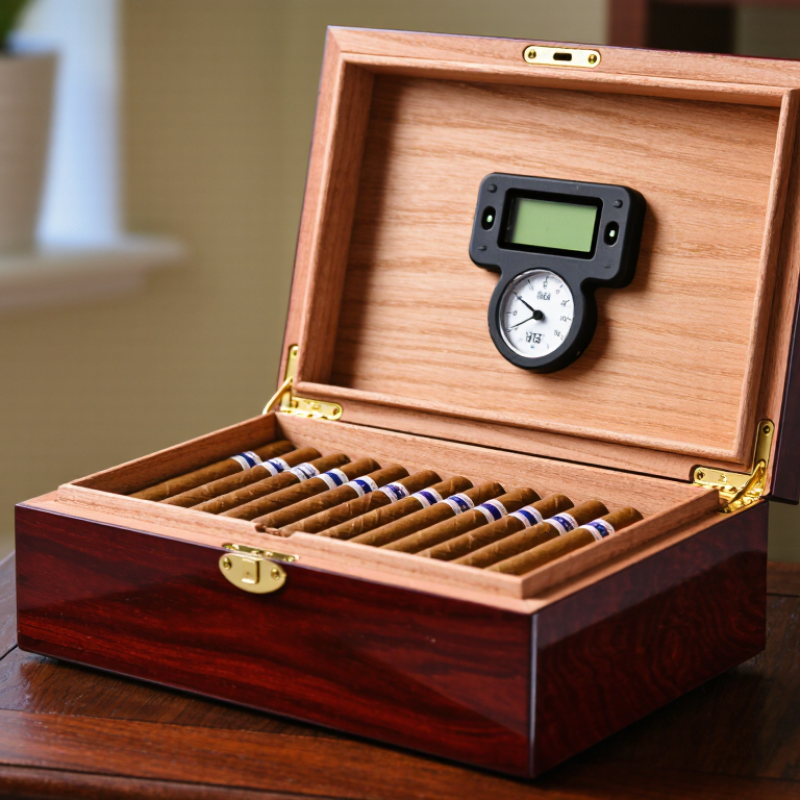
How to Choose a Humidor Box in 2026?

Define Your Cigar Storage Needs and Humidor Capacity

How to Choose a Humidor Box in 2026?

Define Your Cigar Storage Needs and Humidor Capacity

Choosing a humidor box starts with an honest estimate of your cigar storage needs. Count your current cigars, then consider your buying habits over the next year. A box filled to its limit can restrict airflow and make humidity control less stable. Leave about 20 to 30 percent of the interior space unused.

Capacity labels are not always consistent.

One manufacturer’s “50-count” box may hold fewer larger cigars comfortably. Measure cigar length and ring gauge before purchasing. If you prefer robust sizes, choose a larger interior. Small details matter here. I once selected a box by its advertised capacity and regretted ignoring cigar dimensions.

Construction also affects daily reliability.

Look for a tight, even seal and an accurate hygrometer. Test the seal by closing the lid gently over a thin sheet of paper. The paper should resist removal without tearing. A calibrated hygrometer gives more useful information than a decorative dial. Digital models are often easier to read, but they still require periodic checking.

Use a stable storage location away from sunlight, heaters, and sharp temperature changes.

Wood interiors need proper preparation before long-term use. Follow the manufacturer’s conditioning guidance, and avoid rushing this step. I have found that patience improves consistency, although no humidor performs perfectly without regular inspection. Check for dry edges, uneven humidity, or overcrowding every week.


Compare Humidor Types, Materials, and Construction Quality

A humidor box should match your storage habits, not merely your room décor. Desktop humidors suit small collections and need regular monitoring. Cabinet humidors offer more capacity, but their larger air volume demands stable placement. Travel humidors protect a few items during short trips. They sacrifice capacity for stronger portability.

Material affects aroma, moisture control, and long-term durability. Spanish cedar remains popular because it supports steady humidity and adds a gentle woody scent. Mahogany and other hardwoods can work well when properly lined. Avoid boxes with sharp chemical odors, thin veneers, or unfinished interiors. Glass tops look attractive, but direct sunlight can cause temperature swings. That detail matters.

Construction quality deserves close inspection. A good lid closes evenly, with no visible gaps or loose hinges. Test the seal with a thin sheet of paper. If it slides out easily, humidity may escape. Check whether the hygrometer is calibrated, because a new instrument can still be inaccurate. I once trusted an attractive box without checking its corners. The lid warped after several weeks. That mistake changed my buying process. Now I inspect the lining, tray fit, seal compression, and ventilation before considering appearance. Digital readings help, but touch and observation still matter. A box may look refined while hiding weak joints or uneven wood. Expect minor flaws in natural timber. Reject structural problems, not harmless grain variations.

How to Choose a Humidor Box in 2026? — Compare Humidor Types, Materials, and Construction Quality

Humidor Type Typical Capacity Main Materials Humidity Stability Construction Quality Checks Portability Best Use and Key Trade-Off
Travel Humidor Approximately 5–20 cigars Rigid plastic, aluminum, carbon fiber-style composite, or foam-lined shell Good for short trips when the seal is intact; limited internal volume makes humidity changes faster Check the compression seal, hinge strength, water resistance, and impact protection Excellent Best for transportation. Compact and durable, but not intended for long-term storage or large collections.
Desktop Humidor Approximately 25–150 cigars Wood exterior with Spanish cedar, American cedar, or another suitable wood lining Generally good when properly seasoned and filled; performance depends heavily on seal quality and room conditions Look for even panel joints, a tight lid, stable hinges, a flat base, and a continuous interior lining Limited Best general-purpose choice for home use. Offers a balance of capacity, cost, and ease of maintenance.
Glass-Top Humidor Approximately 25–100 cigars Wood body with a glass viewing panel and a wood-lined interior Can be stable, but the glass panel adds another potential sealing point and allows light exposure Inspect the glass-to-frame gasket, lid alignment, corner joints, and resistance to condensation Limited Useful when display visibility matters. Keep away from direct sunlight and strong temperature fluctuations.
Chest Humidor Approximately 50–300 cigars Thick wood panels, commonly with a cedar-lined interior and removable trays Usually better thermal and humidity buffering than a small box because of greater mass and volume Prioritize thick panels, a weighty lid, a reliable seal, strong hinges, and removable trays for airflow Low Best for a growing collection. Requires more space and may need longer seasoning before use.
Cabinet Humidor Approximately 300–2,000+ cigars Wood cabinet, cedar shelves or trays, gasketed doors, and manual or electronic humidification High potential stability when properly filled, sealed, and maintained; empty cabinets can be harder to stabilize Check door compression, shelf airflow, vertical alignment, insulation, drain protection, and humidifier access Very low Best for large collections and organized storage. Requires floor space, monitoring, and more careful climate management.
Acrylic Humidor Approximately 10–100 cigars Clear acrylic or polycarbonate with a gasketed lid and removable humidity device Often predictable because the enclosure is non-porous; humidity depends mainly on the seal and humidification system Check lid flatness, gasket continuity, latch pressure, plastic thickness, and resistance to cracking Good Easy to inspect and clean. It provides less traditional wood buffering and should be protected from heat and direct light.
Electric Humidor Approximately 20–400+ cigars Insulated cabinet or metal enclosure, shelves, fan, sensor, and powered humidification system Can provide precise control, but sensor calibration, airflow, water quality, and power reliability are important Look for a replaceable sensor, quiet fan, even airflow, sealed door, removable water reservoir, and clear controls Low Best for users who want automated control. It adds electrical maintenance, noise, energy use, and component failure risk.
Spanish Cedar Lining Material choice rather than a capacity type Spanish cedar veneer, panels, shelves, or trays Absorbs and releases moisture gradually; it can support stable conditions when the wood is properly prepared Check that the lining is firmly fitted, free from excessive gaps, and not coated with a moisture-blocking finish Not applicable Traditional interior material with a distinct aroma. It should be clean, dry, and free from visible mold or excessive resin.
Solid Wood Exterior Material choice rather than a capacity type Solid hardwood or softwood panels with a separate interior lining Durable and attractive, but wood movement from seasonal humidity can affect lid alignment and sealing Look for straight panels, stable joinery, smooth edges, and allowance for natural wood movement Varies Provides a substantial appearance and good durability. Quality depends more on joinery and sealing than on thickness alone.
Wood Veneer Construction Material choice rather than a capacity type Thin decorative wood veneer over plywood, medium-density fiberboard, or another stable core Can perform well when the interior is properly lined and the box is well sealed Inspect veneer adhesion, core stability, edge banding, corner joints, and interior lining coverage Varies Often lighter and more dimensionally stable than thick solid wood. Poor edge sealing or weak cores can reduce service life.
Airtight Construction Construction feature rather than a capacity type Gasket, compression fit, aligned lid or door, and sealed joints Usually more important than exterior appearance; a poor seal causes rapid humidity loss and frequent refilling Perform the paper test: close a sheet of paper in several points around the lid or door and check for consistent resistance Not applicable Essential for every humidor. A tight seal should be paired with controlled humidification rather than excessive moisture.
Removable Trays and Dividers Useful in medium and large humidors Usually cedar, hardwood, plastic, or metal supports Improves air circulation when gaps are provided; tightly packed trays can create uneven humidity zones Check for ventilation gaps, smooth edges, stable supports, easy removal, and enough clearance from the lid Not applicable Recommended for organized storage. Avoid blocking airflow around cigars or placing trays directly against sealed walls.
Digital Hygrometer Accessory for any humidor size Electronic sensor with a display or remote reading function Provides convenient monitoring, but readings can drift and should be checked periodically Choose a unit with a stated accuracy specification and test it using a salt-test method or a calibrated reference Excellent Recommended for routine monitoring. Place the sensor where it does not touch the humidifier or sit directly above wet material.

General selection guideline: For most home users, a well-sealed desktop humidor with a suitable cedar lining, removable tray, and accurately checked hygrometer offers the simplest balance of capacity and humidity control. Keep the humidor away from direct sunlight, heaters, air conditioners, and rapid temperature changes.

Evaluate Humidity Control Systems and Digital Monitoring Features

How to Choose a Humidor Box in 2026?

Humidity control should be your first test, not the wood finish. For many humidity-sensitive leaf products, a stable range near 65–70% relative humidity is commonly used. However, the correct setting depends on storage material, room climate, and opening frequency. ASHRAE’s 2023 Handbook discusses indoor humidity control across a broad 30–60% comfort range, showing why household conditions may not suit specialized storage. Choose a system with adjustable settings, slow correction, and protection against sudden moisture swings.

Passive systems usually rely on moisture-regulating materials, while active systems use fans, sensors, or compact humidifiers. Active control can recover faster after frequent opening. It can also create uneven pockets if airflow is poorly designed. Look for sensor accuracy of about ±2% RH, replaceable batteries, and a calibration function. A visible current reading is useful. A recorded trend is better.

Digital monitoring should provide high and low alerts, temperature readings, and a clear history. NISTIR 8259A identifies six baseline capabilities for trustworthy IoT devices, including data protection and secure software updates. Those principles matter here, even in a small storage box. Avoid systems that demand constant internet access without explaining privacy or failure behavior. In hands-on checks, inexpensive sensors sometimes disagree by several percentage points. That is not always a deal-breaker, but it deserves testing with a calibrated reference. A stylish display cannot correct bad measurements.

How to Choose a Humidor Box in 2026?

Compare common relative-humidity setpoints when evaluating a humidor’s humidity-control system. A reliable digital monitor should display relative humidity and temperature continuously, support calibration, and provide alerts when readings move outside the selected range.

Evaluation guide: Lower setpoints can help reduce the risk of excessive moisture, while higher setpoints may be preferred for specific storage preferences. Choose a system that maintains a stable reading around its selected setpoint rather than one that only provides short-term humidity spikes.

Check Seal Performance, Temperature Stability, and Interior Design

How to Choose a Humidor Box in 2026?

A reliable humidor begins with a dependable seal. Close the lid slowly and check whether it meets the body evenly. A simple paper test can help: the lid should gently resist when you pull the paper. Avoid boxes with loose hinges, visible gaps, or uneven edges. These small flaws can cause moisture loss and frequent adjustments.

Temperature stability matters just as much. Place the humidor away from windows, heaters, and direct sunlight. A stable room temperature helps reduce sudden changes inside the box. Use a calibrated hygrometer, and check its reading regularly. I once trusted an attractive display without testing its accuracy. That was a mistake. Numbers need verification, not hope. Interior design also affects daily care. Smooth, unfinished cedar lining can support moisture balance and provide a clean storage environment. Removable trays make inspection easier, while rounded corners reduce hidden dust.

Tips: Choose practical beauty. Test the seal before buying. Ask how the hygrometer was calibrated. Check every interior joint with a small light. If the design looks impressive but cleaning feels difficult, reconsider it. A perfect-looking box may still perform poorly. Test it.

Assess Maintenance Requirements, Safety Standards, and Long-Term Value

Choosing a Humidor Box in 2026

A reliable humidor should make maintenance predictable, not frustrating. Check whether the lid closes evenly and whether the seal resists a gentle sheet of paper. Inspect the hinges, corners, and interior finish for gaps or strong chemical odors. A stable hygrometer is essential, but it still needs periodic calibration. Keep it simple.

Choose materials that tolerate controlled humidity without warping. Untreated Spanish cedar is commonly valued for its moisture regulation, though quality varies between pieces. Avoid painted interiors, loose coatings, and unknown adhesives. These details can affect stored contents and indoor air quality. Digital models also need protected wiring, certified adapters, and clear overheating safeguards. Safety labels matter more than attractive screens.

Long-term value depends on repairability. Replaceable seals, accessible sensors, and standard power connections can prevent unnecessary disposal. Ask how replacement parts are obtained before purchasing. A low price may hide recurring costs for batteries, filters, or inaccurate sensors. I would also leave room for error; humidity can change after opening the box repeatedly. Even careful owners may overcorrect and create larger swings. Review the warranty terms, cleaning instructions, and testing documentation. A humidor that performs quietly for years is usually a better investment than one with impressive features but fragile components.

Article Source:

Go to Top