How to Choose the Right Industrial Network Switch for Your Needs?
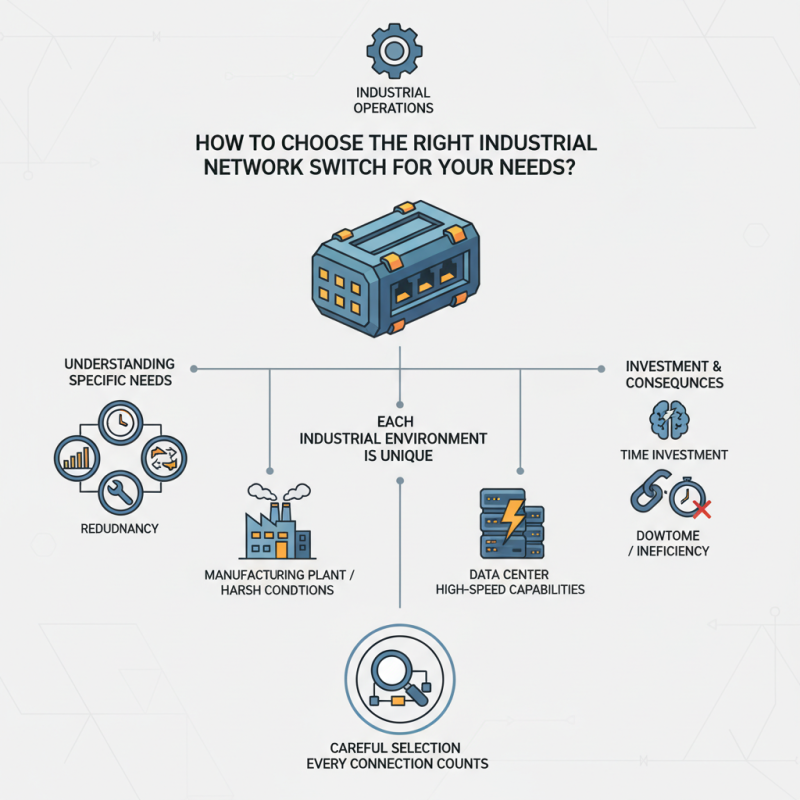
Choosing the right industrial network switch is crucial. Experts like John McCase, a renowned figure in network technology, emphasize, “Quality connections are the backbone of industrial operations.” Selecting an industrial network switch goes beyond just specifications. It involves understanding specific needs, such as bandwidth, latency, and redundancy.
Each industrial environment is unique. For instance, a manufacturing plant may require rugged switches that withstand harsh conditions. In contrast, a data center might prioritize high-speed capabilities. Failing to consider these factors can lead to significant setbacks and inefficiencies.
Investing time in this decision is essential. A mismatched switch may hinder performance. You might face downtime, affecting productivity. Reflect on your options carefully. The stakes are high in an industrial setting, where every connection counts.
Understanding Different Types of Industrial Network Switches Available Today
Industrial network switches come in various types. Each type addresses different needs and environments. The primary categories include unmanaged, managed, and smart switches. Unmanaged switches are simple and plug-and-play. They require minimal setup. However, they lack advanced functionalities, which may limit flexibility.
Managed switches offer greater control and monitoring. They enable VLAN configurations and network management. This helps users maintain better performance. Smart switches fall somewhere in between. They provide basic management features but are less complex than fully managed switches. Choosing the right type depends on your specific requirements and network size.
Environmental conditions matter too. Industrial switches are often built to withstand harsher conditions. They can operate in extreme temperatures and resist dust or moisture. However, not all industrial switches are the same. Some may not support advanced data features, leading to potential limitations. Reflecting on these aspects is crucial for making an informed decision.
How to Choose the Right Industrial Network Switch for Your Needs?
| Switch Type | Port Count | Supported Protocols | Management Type | Environmental Rating | Typical Use Cases |
| Unmanaged Switch | 5-48 | Ethernet, Fast Ethernet | Unmanaged | Standard (0°C to 60°C) | Basic connectivity in less demanding environments |
| Managed Switch | 8-48 | Ethernet, VLAN, Quality of Service | Fully Managed | -40°C to 75°C | Industrial applications with high traffic |
| PoE Switch | 8-24 | Ethernet, PoE, PoE+ | Smart Managed | -40°C to 75°C | Powering IP cameras, phones, and access points |
| Redundant Switch | 16-32 | Ethernet, STP, RSTP | Fully Managed | -40°C to 85°C | Applications requiring high availability |
Key Factors to Consider When Choosing an Industrial Network Switch
Choosing the right industrial network switch involves multiple key factors. One significant aspect is the environment where the switch will operate. These switches must withstand harsh conditions. For instance, they should handle extreme temperatures, dust, and moisture. According to market research, about 40% of industrial network failures are due to environmental factors.
Another critical factor is the number of ports. More ports allow for greater connectivity. Some facilities may require switches with up to 48 ports, especially in complex networks. Oversizing can be costly, while undersizing may lead to data bottlenecks. Understanding your current and future needs is vital.
**Tips:** Always check the switch's MTBF (Mean Time Between Failures). High MTBF indicates reliability. Also, look for modular designs that allow for easy upgrades.
Security features are increasingly important. Industrial networks face cyber threats. Data shows that 70% of industrial companies have experienced a cyberattack. Implementing robust security measures is essential. Ensure the switch supports VLANs and access control lists. These features help segment the network and protect sensitive data.
Consideration of power requirements is also necessary. PoE (Power over Ethernet) could be vital for devices like IP cameras. This saves installation costs and simplifies cabling.
Identifying and reflecting on these needs can help in selecting the most appropriate industrial network switch for your operation.
Industrial Network Switch Comparison
This bar chart compares key features of industrial network switches, focusing on elements such as port count, data transmission speed, operating temperature range, redundancy features, and management options. Use this information to make an informed choice for your industrial networking needs.
Analyzing Performance Metrics: Throughput, Latency, and Reliability Standards
When selecting an industrial network switch, understanding performance metrics is crucial. Throughput indicates how much data can flow through the switch. A high throughput is essential for heavy data applications, like video streaming. However, reaching high throughput often results in increasing latency. Latency measures the delay experienced during data transmission. An ideal switch minimizes latency while maximizing throughput. A trade-off exists, and finding the balance can be challenging.
Reliability standards are equally important. A reliable switch should operate continuously without failure. Look for specifications that outline mean time between failures (MTBF). The environment can affect reliability too. High temperatures or humidity levels may impact performance. Frequent maintenance may also be required in harsh conditions. A dedicated team to monitor the network can help, but it adds to the cost.
Assessing these metrics is not straightforward. Some switches claim high throughput, yet they struggle with latency. Others excel in low-latency environments but have limited throughput. It’s vital to review real-world performance data. User experiences can offer insight into the switch's capabilities. Testing the switch in your specific application is always a smart move. Ultimately, the right choice is about matching the switch's features to your operational demands.
Evaluating Environmental Ratings for Industrial Network Switches
When selecting an industrial network switch, environmental ratings are crucial. These ratings indicate how well a switch can withstand harsh conditions. Factors such as temperature, humidity, and dust levels matter. For example, an IP rating helps determine water and dust resistance. A higher IP rating means more protection.
Consider operating temperature ranges as well. Some switches operate well in extreme heat or cold. If installed in a factory, fluctuations can affect performance. Vibration and shock ratings are equally important. Switches in industrial settings often face rough handling. A weak design may lead to failures.
Evaluating these factors requires careful consideration. Not all switches meet every environmental need. It is essential to assess your specific conditions. In the end, making the right choice can prevent costly downtime. Careful research is essential here; it pays off in the long run.
Future-Proofing Your Network: Scalability and Upgrade Options to Consider
When considering industrial network switches, scalability is key. As your business grows, your network must adapt. Selecting a switch with modular options can simplify upgrades. This flexibility ensures you can add more ports or features as needed. It avoids the costs of replacing the entire setup.
Future-proofing also involves considering the types of connections. Different devices may require varied interfaces. Having a switch that supports various standards now means fewer headaches later. Evaluate your existing equipment to anticipate future needs.
Thinking ahead is vital. However, implementation may not always go smoothly. You might overlook specific future requirements. Network demands can evolve rapidly. Regularly reassess your network strategy to ensure it aligns with growth. A proactive approach helps avoid potential pitfalls in your network design.